Luis Medina’s Changeup Leads 2026 Pitching Superlatives for Whiffs and Weak Contact
Medina’s changeup topped the whiff list, while Aaron Ashby, Fernando Cruz and Zack Wheeler dominated other measures of batters’ discomfort.

The pitches that stood out in 2026 didn’t all win the same way. Luis Medina’s changeup made the most swings miss, Aaron Ashby’s slider left hitters reaching into empty space, and Zack Wheeler’s sinker kept bats jammed near the handle. Those measures offer a different view of pitching results: not just whether a pitch got a miss or contact, but how uncomfortable that contact looked.
Medina’s changeup carried the whiff load
Medina’s changeup was the Whiffiest Pitch in baseball, with a 59.8% whiff rate. Plenty of familiar weapons crowded the top of the leaderboard: breaking pitches from Mason Miller, Adrian Morejon and Chase Burns, plus both the slider and curveball of Aaron Ashby. Medina’s changeup beat them all.
That result came from a pitcher still trying to turn his tools into a reliable major league role. Medina started in 2023 and 2024, posting an ERA above 5.00 in both seasons, then missed 2025 after Tommy John surgery. In 2026, he worked from the bullpen: 73 innings across 60 appearances, a 3.08 ERA and a 29.3% strikeout rate.
The strikeouts came with some clear warning signs. Medina walked 12.3% of hitters, allowed a 90-mph average exit velocity, generated no chases and had trouble keeping the ball on the ground. In short, the whiffs did much of the work. His five-pitch mix—four-seamer, sinker, slider, changeup and curveball—gives him options for a reshaped approach. He led with a four-seamer that was hit hard; more sinkers and sliders could put his best changeup in position to matter more often.
The other end of the contact spectrum belonged to Bryce Miller. His sinker’s 98.3% contact rate made it the Most Hittable Pitch. He threw 162 of them and drew 60 swings, with just one recorded whiff—and even that was a foul tip, which Statcast groups with true misses for this measure.

So Miller’s sinker didn’t actually miss a bat all season. The distinction turns a remarkable contact rate into a small statistical oddity: the pitch was credited with a whiff, but the hitter made contact. Whether that makes it the most hittable pitch or one hitters simply couldn’t miss is left to the reader.
When the ball was in the zone
Whiffs outside the strike zone depend on getting a hitter to chase. A miss over the plate is a different challenge. Dylan Cease’s changeup earned a 50% whiff rate inside the zone in 2026; no other pitch reached 45%. That made it the year’s Zone Whiffiest Pitch.
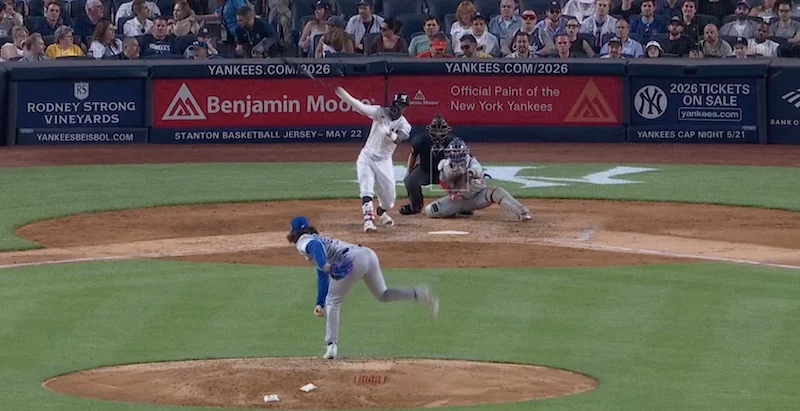
The image captures Cease’s biggest changeup miss of the season at the moment the ball reaches the catcher’s mitt. Jazz Chisholm Jr. was 21.8 inches away. Statcast recorded no intercept point, a sign of just how completely the swing missed its target.
Ashby’s slider ranked second in whiff rate, but took two other distinctions. Statcast’s miss-distance measure put it first: hitters missed by an average of 10.7 inches, earning it the Missiest Pitch title. They were so far out in front that their average bat speed fell to 69.3 mph, the lowest figure for any pitch. That also made Ashby’s slider the Bat-Slowingest Pitch.

The clip shows the scale of the misses. At the closest point, Ryan McMahon’s bat barrel was still 36.8 inches from the ball. The slider fooled him, and his swing came far too early.
Early and deep contact points
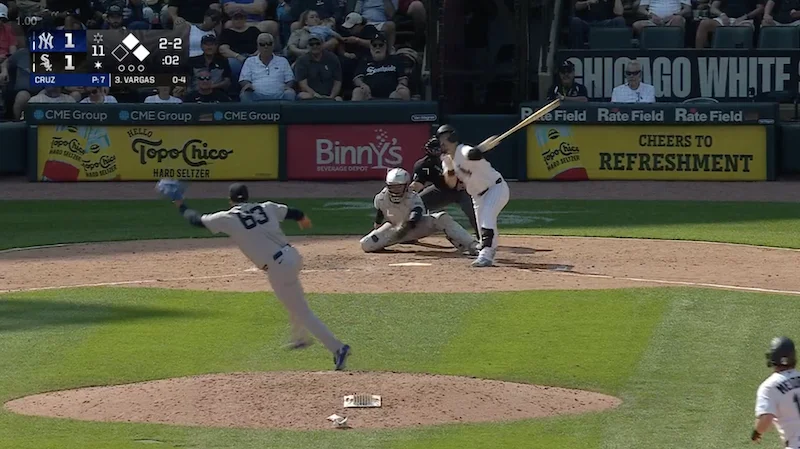
Another way to describe a mistimed swing is to measure where the bat and ball would meet relative to the hitter. Fernando Cruz’s splitter pushed that point farthest in front. Its average intercept point was 47.8 inches ahead of the batter, compared with a league average of 30.2 inches. That earned it the Reachiest Pitch title.
Cruz said he hadn’t known he led the category. “Hitting is about timing,” he said. “You do certain moves to be able to have a 12- or 14-mph differential with the same movement, the same aggressiveness. That’s what it’s all about.”
Miguel Vargas provided the most extreme example: his intercept point against Cruz’s splitter was 71.5 inches ahead of his center of mass. The still shows Vargas nearly finished with his swing by the time the ball reaches the catcher.
On the opposite end, Drew Sommers’ sinker reached hitters deepest, making it the Deepest Pitch. The explanation is in the delivery and speed together. Sommers is a side-arming lefty with 98th-percentile extension, and his sinker averaged 95 mph. Left-handed pitchers with an arm angle between 10 and -10 degrees averaged 91.2 mph on fastballs this season. Sommers’ extra velocity, released from that angle and extension, made the pitch arrive unusually deep.
The deepest example wasn’t a miss: Josh Naylor fouled it off with the bat meeting the ball just 0.4 inches in front of his center of mass. He struck out on the next pitch.
Jammed swings, soft contact and popups
Statcast’s tied-up and flailing measures add another view of discomfort on swings that miss. A hitter is tied up when the intercept point is closer to the bat’s knob than desired; flailing describes a point closer to the barrel’s end. By the tied-up measure, Wheeler was the clear leader. His sinker had a 38% tied-up rate, and his cutter ranked second at 34%. No other pitcher topped 30%, making Zack Wheeler the Jammiest Pitcher of 2026, with the sinker as the Jammiest Pitch.
Ceddanne Rafaela shows what the measure captures: Wheeler’s pitch gets him on the handle, with little room to make solid contact.
Hunter Gaddis’ changeup, which had a 15.4-mph velocity gap from his four-seamer, was the Hardest Pitch to Hit Hard. Gaddis threw 196 changeups and allowed no hard-hit contact on them. The lone ball recorded as hard-hit was a foul. His hardest-hit fair ball against the pitch was a 227-foot single at 90.5 mph; it was also the only changeup batted ball against him to reach 90 mph.
Launch angle separates two more standouts. Morejon’s changeup was the Most Earthbound Pitch: hitters’ barrels finished above the pitch 63% of the time, tied with Ashby’s curveball for the highest rate. The changeup’s 13-degree launch angle was the second-lowest, its 77% groundball rate the third-highest, and balls put in play averaged just 72 feet in the air. That much downward contact came with an unusual cost: three Baltimore chops, hit at launch angles of -73, -65 and -46 degrees, became singles.
Morejon’s four-seamer also kept hitters from squaring him up; they swung underneath it 62% of the time, the 10th-highest rate in baseball. For popups, though, the top honor went to Sandy Alcantara’s sweeper. Its 32% popup rate led the league, and its 36-degree average launch angle came close to the top mark. Those airborne balls traveled an average of 204 feet.

The clip of Bryce Harper puts the sweeper’s effect on display: a popup that rises almost straight up. Across these measures, the season’s defining pitches made hitters miss, reach, jam or lift the ball without authority. The final installment of the series turns to the opposite extreme: the pitch that breaks the least.