2026 Pitching Superlatives: Vesia’s Rise, McLean’s Curve and Ragans’ Total Break
Alex Vesia topped the rise charts, while Cole Ragans’ four-seamer edged Nolan McLean’s curveball for the most total movement.

Cole Ragans’ four-seamer had more total break than any other pitch in this 2026 movement survey, narrowly topping Nolan McLean’s curveball. That result captures the tricky part of judging movement: a pitch’s shape on a screen can be striking, but its measured break depends on how vertical and horizontal forces combine—and what the hitter expects to see.
This is the second installment of the 2026 pitching superlatives series. The first examined velocity; this one sorts pitches by their movement. Before getting to the categories, though, there’s a correction to the previous installment’s slowest-pitch claim.
James McCann was credited with throwing the slowest tracked pitch of the season. That distinction doesn’t cover every pitch: 21 times, a position player threw one so unusual that Statcast assigned no velocity at all. The system may have struggled because some were exceptionally slow or followed a high arc beyond its expected tracking path. McCann threw more of those untracked pitches than anyone else, so his pitch could still have been the slowest overall. It’s simply impossible to confirm which one.
Gravity changes the vertical picture
Movement can mean different things depending on what the measurement includes. Total downward movement counts gravity’s effect from the pitch’s initial trajectory. Induced vertical break, or IVB, isolates movement created by spin. Every pitch in the season dropped at least two inches from its initial path once gravity was included, even those with the most IVB.
That distinction gives the season’s most extreme total drop to an eephus: a pitch that begins by traveling upward and then falls back toward the plate. McCann’s offering dropped 330 inches. Had gravity switched off after release, it would have crossed the plate 31 feet and four inches above the ground. That’s an eye-catching measurement, but it doesn’t make an eephus the most useful comparison for conventional pitch movement. So, for the main superlatives, the search turns to pitches thrown by pitchers—and excludes accidental eephuses.
The Droppiest Pitch among those pitches was Max Fried’s curveball, which averaged 68.1 inches of downward movement: five feet and eight inches from its release angle. Here, the total-drop figure puts the pitch’s trajectory in perspective, including gravity’s contribution.
At the other extreme, Miami’s Michael Petersen earned the Unfallingest Pitch distinction. His four-seamer averaged just 9.2 inches of total drop. He shares the company at the top of the list with high-spin four-seamers from Trevor Megill, Chase Burns and Mason Miller.
Petersen’s four-seamer combines velocity and spin with a 54.5-degree arm angle, helping him impart backspin. Statcast recorded 99.5% active spin on the pitch, the 10th-highest mark in baseball. That means nearly all of its spin contributes to movement. Even so, its 19.4 inches of IVB put it just outside the top 10. Total drop and IVB describe related, but different, aspects of a pitch.
Vesia’s fastball rises by the numbers
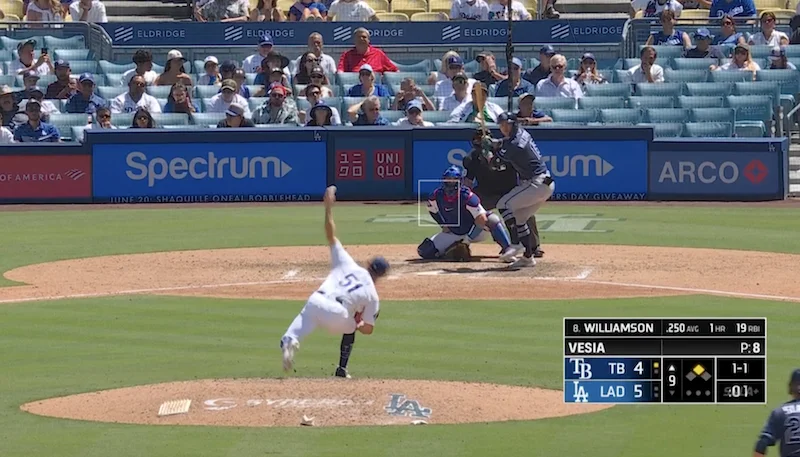
Alex Vesia of the Dodgers led the Risiest Pitch category with 21.2 inches of IVB on his four-seamer. The pitch appears to jump as it leaves his hand, and its measured spin-driven lift backs up that impression.
Vesia averages 92.1 mph with the fastball, so it spends longer traveling to the plate than Petersen’s harder offering. More time in flight gives gravity longer to pull the ball downward, increasing its total drop. It also gives Vesia’s spin more time to push against gravity, which helps explain the fastball’s high IVB.
His arm angle adds another distinctive element. Vesia averaged 69 degrees on his four-seamer, the highest in baseball, and 73.8 degrees on his slider. Since Statcast adopted Hawk-Eye tracking in 2021, only one four-seamer has posted more IVB: Demarcus Evans averaged 22.3 inches in 2021. Vesia’s fastball is second across that period.
The Droppiest Curveball by IVB belongs to Matthew Liberatore. His curveball averaged -17.2 inches, the largest induced drop for any pitch in baseball. Fried’s curveball ranked sixth. Aaron Ashby came in second, Hunter Brown eighth, and Yoshinobu Yamamoto 10th.
Liberatore’s curve has an unusually forceful spin profile. His arm wraps around his body in the follow-through as he pulls down on the pitch to create that rotation. The movement is dramatic; controlling its location makes the result especially striking.
Sinkers and changeups test the labels
Tyler Rogers technically won the Sinkiest Sinker category, with -12.5 inches of IVB on average. His most extreme sinker registered -13.1 inches. But Rogers throws from a submarine arm slot, which changes how the pitch looks to a viewer: the ball can appear to rise even as its measured IVB shows downward movement.
To compare with a more conventional release point, the nearest qualifying pitcher was Logan Webb, whose arm angle is 23 degrees. Webb’s sinker averaged 0.1 inches of IVB—slightly more rise than drop. That was the lowest average among non-sidearmers. Some individual sinkers do drop: Webb’s most extreme of the season had -6.6 inches of IVB, including a pitch to Caleb Durbin.
The comparison leaves an awkward label for a pitch designed to sink. Sidearmers such as Tim Hill, Kevin Kelly and Yennier Cano fill out the upper ranks, while a conventional arm slot makes it harder to produce negative IVB on a sinker. The pitch’s name doesn’t guarantee that it will register as moving downward against the spin-only measure.
Kelly’s changeup takes the Droppiest Changeup title, averaging -7.5 inches of IVB within 44.9 inches of total drop. About 83% of that drop came from gravity. Sidearmers remain in this category because changeups often depend on reducing spin and allowing gravity to shape the flight. The numbers are modest by IVB standards; the pitch is still satisfying to watch.
Horizontal break brings two standout shapes
Gravity doesn’t drag a pitch sideways in the same way it pulls it down, so the horizontal categories are more direct. Devin Williams’ changeup, known as the Airbender, claimed the Tailiest Pitch superlative with an average 20.7 inches of arm-side run. That’s more than an inch ahead of the second-place changeup from Logan Henderson. Williams’ biggest breaker reached 33 inches of arm-side run, though it wasn’t a competitive pitch.
The Sweepiest Sweeper award went to left-hander Cade Gibson. He led baseball with an average 21.5 inches of glove-side break, and his most sweeping pitch reached 27.4 inches. The visual effect depends partly on the broadcast angle. Cameras generally show pitches from the pitcher’s right side, which can make a left-hander’s movement appear less dramatic from right to left across the screen. Gibson’s break remains substantial; a view over his left shoulder might make it easier to appreciate.
Ragans tops the total-break chart
To identify the pitch with the most combined vertical and horizontal break, both measurements have to be considered together. The Pythagorean theorem provides the calculation: the two directions are the sides of a right triangle, and the total break is its hypotenuse.
McLean’s curveball averaged 17.5 inches of horizontal break and -13 inches of IVB, producing 21.8 inches of total break. That earned him the Breakiest Breaking Ball and Curviest Curveball distinctions.
Yet the pitch with the most total movement was a four-seamer. Cole Ragans averaged 12.8 inches of horizontal break and 17.8 inches of IVB, just edging McLean’s curve at 21.9 inches by the combined measurement. Ragans’ biggest-moving four-seamer reached 26.2 inches of total break.
As with Vesia, the broadcast view can disguise the shape. Ragans is a left-hander, and the camera angle makes his fastball look as if it drifts away from its intended path. The movement figures tell a different story: the pitch combined meaningful horizontal action with lift, narrowly taking the overall title.
Movement needs a pitching context
The season’s most extreme measurements don’t automatically identify the most effective pitches. A viewing angle can make a pitch’s movement look larger or smaller, while a hitter’s expectations shape whether that movement creates a difficult look. The interaction between spin, release point, velocity and approach angle is what gives movement its meaning.
A four-seamer with plenty of IVB may not miss bats if its release point makes its path too flat—or if its shape fits too neatly with the pitcher’s arm angle and becomes easier to anticipate. A sweeper can rack up horizontal break while sacrificing enough velocity that a tighter slider would be more useful. And a pitch’s break has to work within the pitcher’s full mix, not in isolation.
That’s why the category winners are best read as striking examples of pitch shape, rather than a ranked list of the season’s most effective offerings. The numbers show what the ball did; the release, approach and hitter’s read help explain why it mattered. Next in the series: pitch location.