Shane Drohan’s Long Road to the World Series Nearly Ended in a Brewers Sweep
Milwaukee came within three outs of a sweep, but Shane Drohan’s late-season revival ended with four straight singles and a Game 5.
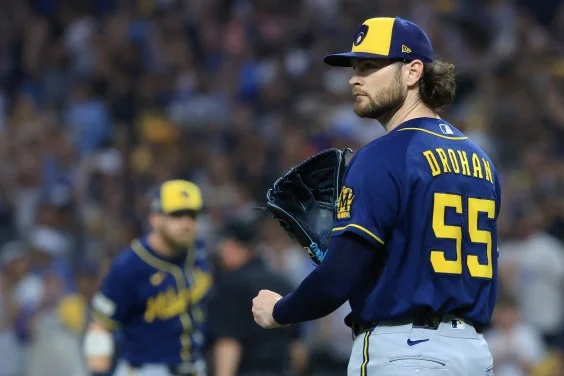
Shane Drohan’s season had already defied a clean ending. The Brewers gave him a chance to close out the World Series and complete a four-game sweep, but he couldn’t record an out. Four consecutive singles turned Milwaukee’s celebration into a wait for Game 5—and left Drohan’s winding route back to the majors as one of the series’ sharpest side stories.
Milwaukee had moved within three outs of its first World Series championship after Cooper Pratt homered in the top of the 12th inning. The shot put the Brewers ahead 3-2, but neither Antonio Senzatela nor Drohan could finish the bottom half. All five Rays reached safely, with Ben Williamson delivering the game-winning single.
The result kept the Brewers out of the 11-1 Club, alongside the 2005 White Sox and 1999 Yankees. They also lost the chance to become the first team to sweep both the League Championship Series and World Series since both rounds became best-of-seven in 1985. Their eight-game postseason winning streak stopped short of the record and matched runs by the 2005 White Sox, 2019 Nationals, 2014 Royals and 2004 Red Sox.
A winding route back
Drohan’s appearance carried a long backstory for a pitcher Milwaukee had signed to a minor league deal. The White Sox selected him in the 2024 Rule 5 draft, a move that briefly made his ability to stick on their 26-man roster a test of the club’s player evaluation. Nerve decompression surgery during spring training derailed that attempt. A rehabilitation stint wasn’t a workable way to carry him on the roster, so he returned to the Red Sox.
Boston got only two more appearances from Drohan before shoulder trouble intervened again. He found his form in 2025, but forearm issues put him on the shelf during the season and left him running short on time with the Red Sox. Milwaukee offered another opening. After starting the year at Triple-A Nashville, he reached the majors in the second half of April and stayed there.
Drohan finished with 124 ⅔ innings across 33 games, including 19 starts. The Brewers went 23-10 in games he pitched, a striking contribution from someone who began the season outside the majors. That workload and team record gave his World Series opportunity real weight: Milwaukee had found substantial value in a pitcher whose recent seasons had been interrupted by surgery and recurring arm problems.
There was a catch. Drohan hadn’t pitched in a month before entering Game 4. He inherited a runner on first after a Joey Ortiz error, then allowed four straight singles. That sequence decided the game, but it doesn’t erase the unexpected work he supplied over the season. It does explain why the possible final out had felt like such a fitting cap: a late-season pickup, back in form, asked to finish the most consequential game of his year.
The game that kept going
The tension had been building across a World Series in which small decisions and baserunning outs had often mattered as much as the big swings. Milwaukee’s late lead seemed to offer a sudden release. Instead, the home crowd’s roar after Pratt’s homer became disorienting for a viewer accustomed to treating stadium noise as a cue: the visiting team had just gone ahead, yet Tropicana Field was celebrating.
That reversal made the bottom of the 12th feel less like a routine closing task than a fresh contest. The Brewers needed three outs to finish a sweep; the Rays needed to keep extending the series. Once the first runner reached and the singles kept coming, the pressure shifted pitch by pitch. Williamson’s hit settled the immediate question and sent the teams to Game 5.
Drohan’s near-miss also captured the uncertainty in Milwaukee’s run. The Brewers had come close to a historic finish, with a chance to sweep both rounds and push their winning streak past eight. Instead, the Rays forced another game, while the record for consecutive postseason wins remained shared by four earlier clubs. One inning changed both the series’ shape and the story attached to Drohan’s season.
More from around baseball
Milwaukee’s traveling supporters kept making their presence felt during the series. Brewers fans priced out of the World Series in Milwaukee took their party to Florida, and another report described fans at a St. Petersburg sports bar drinking it out of Miller Lite. The crowd atmosphere became its own thread running alongside the close games.
The on-field details have offered plenty to examine, too. Sam Miller’s look at the execution of small things takes stock of the bunting, baserunning and smaller choices shaping the series. That focus fits a matchup where teams have repeatedly traded outs on the bases, and where a single hit—or a missed chance to record an out—has carried outsized consequences.
For the White Sox, Caleb Bonemer’s workload has also become a point of discussion. After 595 regular-season plate appearances, 55 in the Arizona Fall League and 180 outfield innings between the two, the club is letting him call it a season. Eric Longenhagen came away encouraged by Bonemer’s hitting ability and his potential to reach his power. The Fall League’s experimental outfield positioning rules produced more hits, particularly doubles and triples, but also demanded more full-speed running from a player who had already logged a heavy schedule.
The broader lesson from Drohan’s season is easy to miss in the final box score. Milwaukee got 124 ⅔ innings from a pitcher who began the year in Triple-A, then trusted him in a moment that could have sealed a championship. His four-hit sequence will stay attached to that night, but so will the path that made the opportunity possible. With Game 5 still to come, the Brewers’ unexpected contributors remain part of the story—and Drohan’s season has already shown how quickly a second chance can become a central role.